In many woodworking companies, the front end of the production process is well optimized. Profiling, planing, and machining run efficiently, and machines operate at full capacity. Yet at the end of the line, a different picture often emerges. Where the product is finished, the pace slows down and variation in quality and output begins to appear.
This is rarely due to a lack of effort or craftsmanship. In fact, with manual processes such as spraying or coating, it is inherently difficult to achieve consistent results. Each batch is slightly different, each operator works in their own way, and factors such as workload and planning always play a role. As a result, finishing often becomes the least predictable step in the entire process, even though it directly impacts quality, material usage, and delivery times.
Where things start to break down in practice
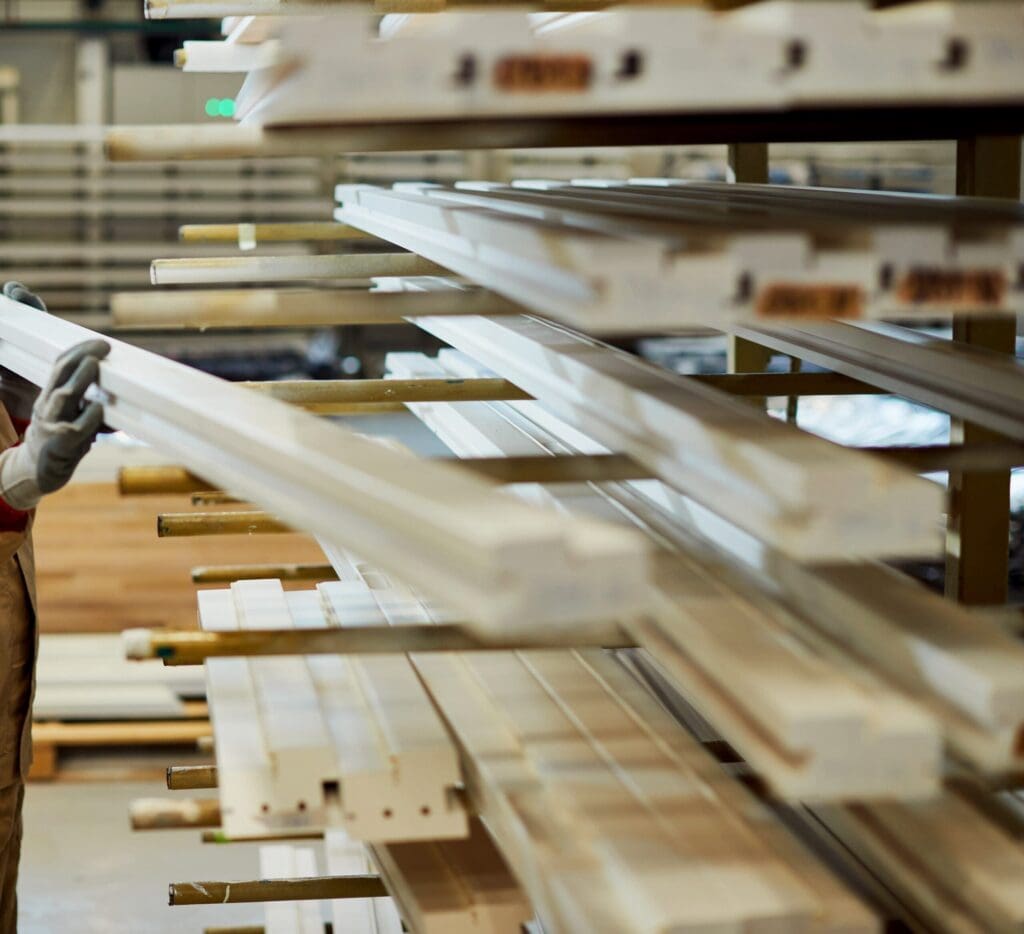
When wooden profiles are coated manually, the process involves multiple steps. Profiles need to be turned to treat all sides, attention must be paid to coverage in grooves and chamfers, and operators must continuously assess whether the coating thickness is sufficient. This requires experience and focus, especially at higher production volumes.
In practice, this process comes under pressure as output increases. Operators work faster, decisions become more pragmatic, and there is a natural tendency to apply slightly more coating to ensure proper coverage. This is understandable behavior, but it does reduce overall efficiency.
At the same time, variation between operators becomes visible. One achieves a consistent, high-quality finish, while another may struggle to maintain the same standard. These differences show up not only in the final product, but also in material consumption and the amount of rework required.
The costs that often go unnoticed
Most companies have a clear understanding of the price of their coatings. What is often less clear is how much of that material is actually used effectively. With manual spraying, a portion is always lost due to overspray and extraction. In addition, there is often an implicit safety margin in the applied thickness to ensure full coverage.
In the short term, this does not seem significant. Per batch, the differences are small and difficult to detect. But over weeks and months, this results in structurally higher consumption than necessary. Especially with more expensive coatings, such as fire-retardant treatments or high-end oils and lacquers, this can have a substantial impact on cost per meter.
Quality also plays a role. Small inconsistencies in coating thickness or coverage do not always lead to immediate rejection, but they do require additional inspection, create uncertainty, and sometimes lead to rework. This takes time and capacity, and makes the process harder to plan reliably. When rejection does occur, costs quickly increase due to additional handling and lost production.
How a vacuum coater works differently
A vacuum coater approaches the coating process in a fundamentally different way. Instead of manually applying coating, profiles are passed through a closed application system where the coating is applied in a controlled manner and excess material is immediately removed.
EasyCoater vacuümcoater
During this process, all sides of the profile are treated in a single pass. Excess coating is removed using a vacuum system, resulting in a consistent layer thickness. This also applies to hard-to-reach areas such as grooves and complex profiles, where manual processes often lead to variation.
Because the system is closed, the coating remains within the process and loss to the environment is significantly reduced. Material that is not applied to the product is reused. This creates a much more controlled and predictable consumption pattern.
What this means for your production
The biggest difference lies in predictability. Where manual coating depends on people and circumstances, a vacuum coater ensures consistent output. The coating thickness is defined by machine settings rather than individual handling, meaning every batch delivers the same result.
This directly improves quality. The risk of runs, insufficient coverage, or inconsistencies is greatly reduced, which minimizes the need for inspection and rework. This not only saves time but also stabilizes production planning.
Material consumption is also reduced, as there is no overspray and no need for safety margins in application. The coating that is used is effectively applied to the product. In many cases, this leads to a noticeable reduction in cost per meter without compromising quality.
Output also changes. Since profiles are treated in a single pass with fewer manual steps, throughput increases. More importantly, output becomes more consistent, making it easier to plan and scale production.
When does this become relevant?
A vacuum coater is not necessary for every company. However, as production volumes increase and manual processes become a limiting factor, this technology quickly becomes relevant. This is especially true for companies working with cladding, rabbet profiles, or complex shapes where consistent coverage is difficult to achieve manually.
It also becomes relevant when there is limited insight into actual consumption per meter, or when rework is a recurring issue. In many cases, companies find that the cost of inefficiency is higher than expected.
From assumption to insight
What is often missing is a clear understanding of the current situation. Many decisions are based on experience and intuition, while this part of the process offers significant opportunities for improvement through measurement and analysis.
By gaining insight into consumption, output, and quality, it becomes clear where the biggest opportunities lie. Only then can you determine whether changes in process or technology will truly add value.
In closing
At Trivec, this always starts with analyzing the current process. Not from the assumption that a new machine is required, but to understand where losses occur and where optimization is possible.
From there, the right solution can be determined based on your specific situation and production scale.