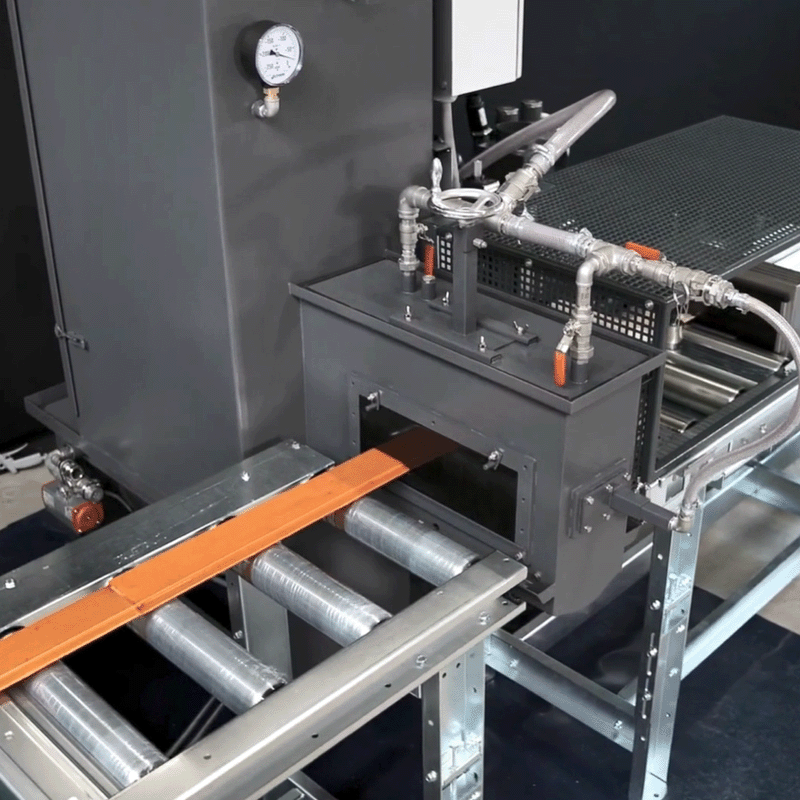
Within the international wood industry, a vacuum coater is often treated as the default answer to production efficiency. The promise is appealing: a flawless, consistent finish on all four sides in a single pass, combined with a predictable cost per meter.
However, in practice at Trivec, we see that this machine, no matter how strong it may look on paper, can also become an expensive bottleneck if the conditions are not right. For us, credibility as a knowledge partner starts with understanding where that boundary lies: the difference between a profitable investment and an operational mistake.
The strategic advantage: When a Vacuum Coater performs at its best
A vacuum coater performs best in an environment where volume and uniformity are the main priorities. For manufacturers of profiles, cladding, and beams, the technology offers a level of coverage that is difficult to achieve with traditional spraying or roller coating.
-
Complex Connections: Especially with products that include complex tongue and groove connections, the vacuum dynamics ensure a homogeneous layer across all surfaces.
-
Quality and Durability: This not only improves the visual result but also supports the durability and long term performance of the final product.
-
High Output: When your organization aims for high output while minimizing manual handling, this type of machine can deliver a strong and predictable return on investment.
-
Minimal Waste: It is particularly suitable for companies that want to achieve a consistent, premium finish without the material loss that is typical of other coating methods.
The critical boundary: When another technique is the better choice
Despite its advantages, a vacuum coater is not universally applicable. In our experience, this boundary is often underestimated.
-
Three Sided Applications: We regularly see requests for vacuum coating in three sided applications with UV lacquer. From a practical perspective, this is a mismatch. The machine is designed for four sided treatment, while a spray system offers more flexibility and efficiency for three sided coating.
-
High Variation and Small Batches: We see similar challenges in environments with a high variation in dimensions and profiles within small batches. In these cases, setup and changeover times increase the cost per meter, reducing or even eliminating the expected efficiency gains.
-
Specialized Coatings: When working with highly viscous or specialized coatings, the process becomes more complex. These often require strict control of viscosity and temperature, which can limit the performance of the system.
In all these situations, the issue is not the machine itself, but the fit within the total process.
What decision makers often overlook
In many cases, the focus is placed on the price of the machine, while the actual return is determined by the performance of the entire production flow. A vacuum coater is only one part of a system that also includes drying, transport, and handling.
Theory vs Practice
On paper, vacuum coaters are capable of speeds up to 50 meters per minute. In practice, most production environments operate between 15 and 25 meters per minute. The limiting factor is rarely the machine itself, but the surrounding process:
-
Drying Capacity: The line can only move as fast as the coating can dry.
-
Material Flow: Efficient handling and transport are essential to maintain pace.
-
Environmental Conditions: The behavior of coatings is sensitive to temperature and humidity. Even small variations can influence the application result and the overall performance of the equipment.
Moving too quickly toward complex production lines without first optimizing the existing process can lead to unnecessary complexity and disappointing results.
From technology to performance
The real challenge is not selecting the most advanced technology, but ensuring that it contributes to a stable and predictable process. That means looking beyond the machine itself and understanding how each step in the production line interacts. Only then can you determine whether a vacuum coater will truly improve efficiency, quality, and cost control.
Your partner in performance
At Trivec, we do not start with a machine, but with your process. Our goal is to translate technical complexity into predictable output and a clear cost per meter. That starts with analyzing your current setup and identifying where losses occur in material usage, variation, or handling.
From there, we determine whether vacuum coating is the right step, or if another solution will deliver better results.
Explore your possibilities We invite you to visit our experience center. Here, we can test your profiles, coatings, and settings under realistic production conditions, giving you direct insight into performance, consumption, and output.